
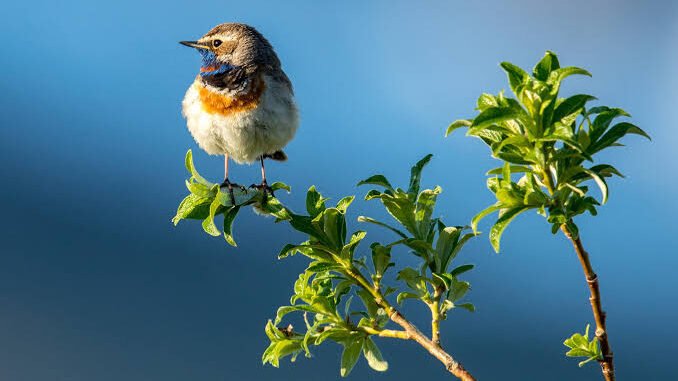
A blue throat is not something you expect to see on a bird the size of a robin, yet that is exactly what makes the bluethroat (Luscinia svecica) so sought after. In spring, the male carries a bright blue bib, and for British birdwatchers a glimpse of that colour is a genuine event. The species is a scarce migrant here rather than a regular resident, which is part of the appeal. This guide explains what a blue throat on a bird means, how to tell the different forms apart, where the bluethroat lives, and how often it turns up in the UK.
What is the bluethroat bird?
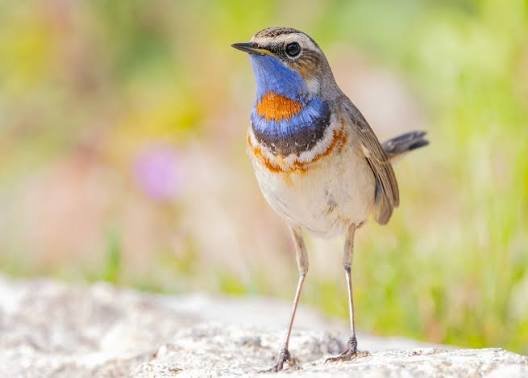
The bluethroat is a small songbird belonging to the chats. It is described by the RSPB as small and robin-like, and it measures roughly 13 to 15 centimetres in length. The BTO records an average adult weight of about 16.7 grams. Males average 16.9 grams and females 16.4 grams, so the sexes are very close in size.
Both sexes have grey upperparts and white underparts, and both show a chestnut patch near the base of the tail that flashes when the bird fans or flicks it. That tail pattern is one of the most useful clues when a bird dives into cover, and you only catch a glimpse. The fully blue throat belongs to the male in breeding plumage, while females lack the blue throat patch.
Blue throat colours: white-spotted and red-spotted forms
When people talk about a blue throat on a bird, they are usually describing the male in spring. The bib is bright blue, bordered below by bands of black, white and chestnut, according to the RSPB. In the middle of the blue sits a spot, and its colour depends on the subspecies. There are two forms that matter most to birdwatchers in Britain: the white-spotted bluethroat and the red-spotted bluethroat.
The BTO notes that the throat colour varies a great deal between individuals, including the intensity of the blue and the shape and colour of any spot. The RSPB adds that the red-spotted form is the more numerous of the two. Because of this variation, two birds can look quite different even when seen on the same day, and that is one reason the species rewards patient observation.
The wider species is divided into several subspecies. One online reference, BirdForum, lists twelve of them, which shows how widely the bird is spread across Europe and Asia and how many local forms have developed.
Where does the bluethroat live?
During the breeding season, the bluethroat favours wooded tundra, open birch forest and willow scrub, usually close to lakes, rivers or swamps. Its breeding range includes most of Norway, upland Sweden and northern Finland, and it stretches from Poland and the Baltic States east to the Urals. There are also scattered pockets further south, including in Spain, western and central France, and parts of central Europe.
Outside the breeding season, it changes habitat. It is found in reedbeds, open grassland and cultivated areas, and BirdForum reports that wintering birds are found in small numbers around the Mediterranean, but more commonly in sub-Saharan Africa and the Middle East. That long journey is why British sightings happen only at certain times of year: the birds are simply passing through.
Bluethroat diet and behaviour
The bluethroat feeds on insects, caterpillars and berries. It forages on the ground, hopping between patches of open soil and vegetation, and it can also catch insects in the air. On passage in the UK, it favours thick vegetation with patches of open ground, often moving from bush to bush. It can be quite secretive, so a good view often depends on staying still and watching the edges of reedbeds, scrub and bushy marshes.
The nest is built mainly from moss, twigs and grass, and lined with animal hair and plant down. A pair typically raises one or two broods a year, with five to seven eggs in each. According to the BTO, the female incubates for about 14 to 15 days, and the chicks fledge after a similar period. The male also defends his territory with an emphatic song, often delivered in mid-flight.
Is the bluethroat a UK bird?
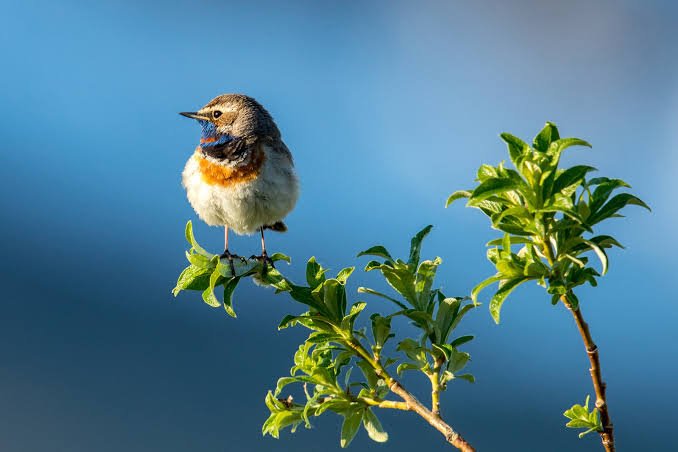
Yes, but only just. The BTO describes the bluethroat as a scarce migrant and a rare vagrant in the UK, and an occasional breeder. The most recent breeding record it lists is from 2016. The first UK record dates back to 1826, in Northumberland, and the BTO holds around 5,000 records in total.
Conservation status depends on which list you read. Globally, the bluethroat is rated Least Concern on the IUCN Red List, and one estimate puts the global breeding population at between roughly 545,000 and 1.38 million pairs. In the UK, the RSPB lists it as Amber. It is also a species for which a Schedule 1 licence is required to disturb it, which means photographers and birdwatchers need to keep a respectful distance, especially if there is any hint of breeding behaviour.
When and where to see a blue throat in Britain
Records occur throughout the year, with a peak in spring and a larger peak in autumn. The pattern in spring is fairly consistent: white-spotted birds can appear from late winter and arrive in early April, while red-spotted birds are more likely from mid-April, with May a good month. Autumn passage runs from August into October, and a small number of birds also pass through in late autumn.
Sightings are mostly coastal. One birdwatching source places them in coastal areas from Lothian in Scotland south to Kent and west to Cornwall. Thick vegetation, reedbeds and bushy marshes near the coast are the best places to look, and local bird alerts are worth following during migration seasons, since an individual may only stay for a day or two.
Some practical tips can help. Arrive early, when birds are active and the light is soft. Scan the base of bushes and the edges of open ground rather than the treetops. Listen for movement low down. And if you spot a robin-sized bird with a flash of chestnut in the tail, take a second look before moving on.
Why the bluethroat matters to birdwatchers
For anyone who enjoys wildlife, the appeal of the bluethroat is that it combines rarity with beauty on a very small scale. It is not a huge predator or a dramatic record-breaker. If you prefer your wildlife stories on a larger scale, we have covered the world’s longest snake ever found, the long-running debate over big cats in the UK, and a rundown of the werewolf looking dog breeds that resemble their wild cousins. The bluethroat sits at the other end of the scale, and it is no less interesting for it.
Seeing one is partly a matter of timing and partly luck. Because the species is a passage migrant in Britain, with no resident or wintering birds, every sighting is a snapshot of a long journey between northern breeding grounds and warmer wintering areas. That is what makes a blue throat flashing in a coastal bush feel like such a reward.
Conclusion
A blue throat on a small, chestnut-tailed bird is almost certainly a male bluethroat, and in Britain that is a sight worth travelling for. Learn the differences between the white-spotted and red-spotted forms, watch the edges of coastal scrub and reedbeds in spring and autumn, and keep a respectful distance. For more on the species, the BTO’s bluethroat factsheet is an excellent place to start.