
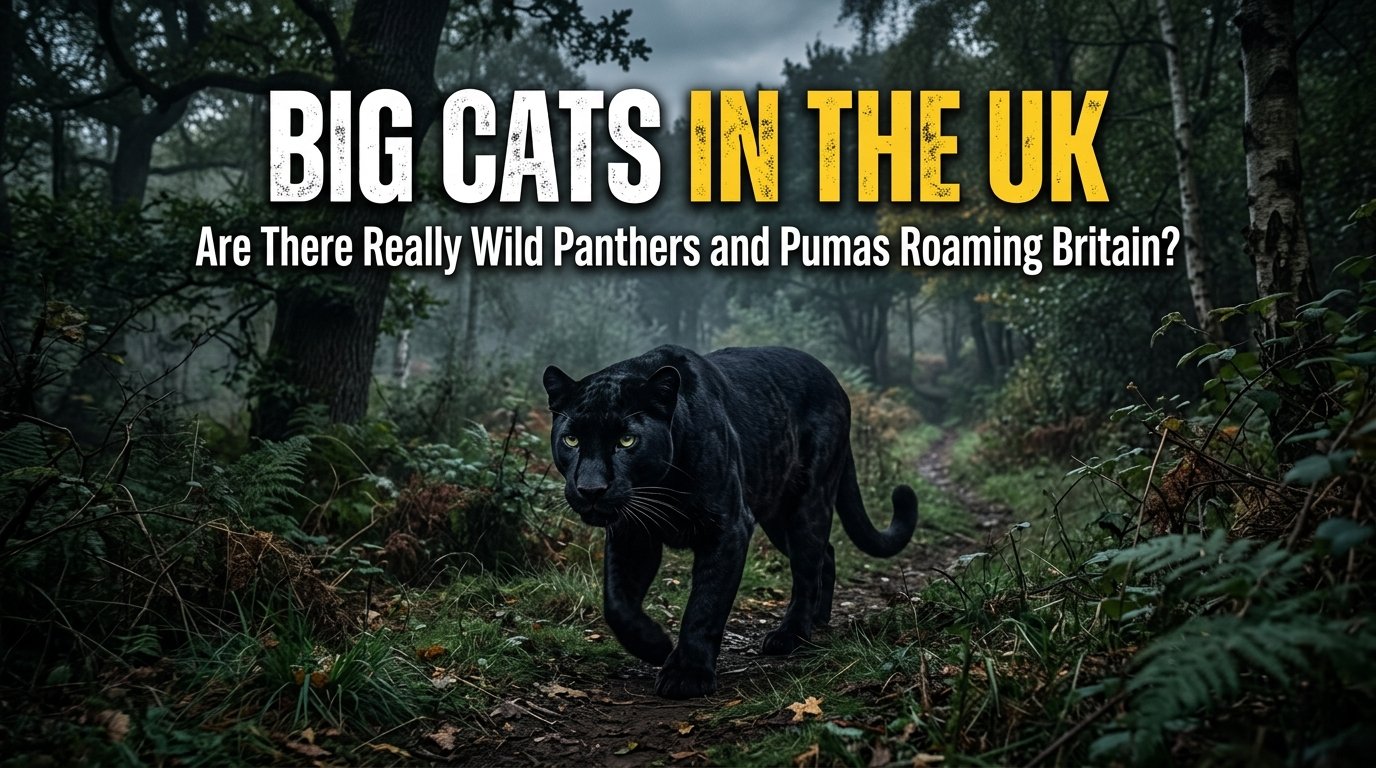
It sounds like the kind of story that belongs in a tabloid from the 1990s — a panther stalking the Somerset countryside, a puma spotted on a Devon hillside, a “lion-sized” black cat disappearing into a Cornish hedgerow. And yet the reports keep coming, the evidence keeps accumulating, and the question refuses to go away. Are there really big cats in the UK?
The short answer, increasingly, appears to be yes. DNA evidence has now confirmed that big cats are prowling the British countryside, and the volume and consistency of eyewitness accounts across Britain is now difficult to dismiss as mere folklore. Here is everything you need to know.
Where did the big cats in the UK come from?
Back in the 1960s and 70s, exotic pets were a fashionable status symbol. Big cats — including leopards and pumas — could even be bought from Harrods. But in 1976, new laws made it illegal to own such animals without a licence. The prevailing theory, supported by most researchers, is that a significant number of privately owned big cats were released into the British countryside when those laws came into force — rather than their owners facing the cost and complexity of obtaining a licence or finding alternative homes for the animals.
A first wave of releases may have occurred even earlier, during wartime, when meat shortages made keeping large exotic pets unsustainable. Since then, further releases and escapes are believed to have contributed to more recent sightings — with Britain offering a relatively stress-free environment with ample prey, woodland cover and a moderate climate that allows these cats to survive and, potentially, thrive.
The evidence for big cats in Britain
The evidence has been building for years, and it now extends well beyond eyewitness accounts. BBC Discover Wildlife Magazine reported in 2025 that large cats such as black leopards are quietly naturalising in Britain. Podcast host and author Rick Minter, who has spent years studying these animals and has collected around 1,500 witness accounts through talks, rural shows and his podcast Big Cat Conversations, believes the case is now compelling. DNA testing has since provided the kind of hard physical evidence that sceptics have long demanded — confirming that something large and feline is out there, and that it most likely belongs to a species not native to these islands.
Minter believes the most likely species behind a number of confirmed encounters is the leopard — specifically the melanistic or black leopard, commonly known as a black panther. His view is supported by the physical descriptions given by witnesses across Britain, which consistently describe a large, dark, long-tailed cat moving with a fluid, purposeful gait entirely unlike that of any domestic animal.
Recent big cat sightings across the UK
The sightings are not historical curiosities — they are ongoing and well-documented. At least 13 sightings of so-called “big cats” have been reported across Devon and Cornwall alone in the past five years, according to official police logs released under a Freedom of Information request. Among the more dramatic: a grey or white feline seen in Helston gardens in June 2024, a “tiger-sized” black cat in Exminster in August 2022, and a spotted cat crossing the road near Penzance in March 2025 — likened by the witness to a lynx. One 2024 sighting on the Camel Trail described a black cat two feet tall and three feet long with a long tail, with officers attending and finding the caller “genuine in his manner.”
More recently, 2026 has brought a fresh round of reports. A sighting in Dorset on Canford Heath near Poole described what a witness believed to be a black panther moving through open heathland. In Wiltshire, a dog walker near Chippenham reported encountering a large cat on a popular countryside footpath — significantly larger than a domestic cat, with a long tail and dark colouring. Further west, a report from Newquay in Cornwall described a large cat seen at distance moving across farmland — Cornwall being one of the regions most frequently associated with Britain’s phantom cats, and home to the legend of the Beast of Bodmin Moor. This story has many parallels with some of Britain’s most compelling mysteries — not unlike the true crime sensation covered in our post on Making a Murderer Season 3, which raised equally uncomfortable questions about what we think we know.
Autumn 2025 brought a particularly active period, with reports surfacing from Suffolk harvest fields to moorland in North Wales — black silhouettes crossing lanes, long tails vanishing between trees, sheep spooked under moonlight, and pointed-ear shapes glimpsed in the gloom. Several witnesses independently set up trail cameras following their encounters, suggesting a level of conviction that goes beyond casual misidentification.
What types of big cats are in the UK?
The most commonly reported species across Britain are black leopards, pumas and lynx. These cats have developed what researchers describe as an almost supernatural ability to avoid detection — moving like shadows even in challenging terrain, their stealth so refined that even in areas with frequent sightings, obtaining clear photographic evidence remains extremely difficult. It is this very elusiveness that has allowed sceptics to maintain their position for so long, despite the growing body of circumstantial and physical evidence.
The Beast of Bodmin Moor in Cornwall is perhaps Britain’s most famous alleged big cat — a creature reported for decades and embedded in the folklore of the South West. But sightings come from every corner of the country, from the Scottish Highlands to the Home Counties, suggesting that if a breeding population exists, it is not confined to any single region.
So are big cats in Britain real?
The weight of evidence — DNA confirmation, consistent police records, 1,500 documented eyewitness accounts and ongoing sightings right up to 2026 — makes it increasingly hard to maintain scepticism. The more compelling question is no longer whether big cats exist in the UK, but how many there are, whether they are breeding, and what, if anything, should be done about it.
Whatever the truth, Britain’s big cat mystery is far from over. As DNA testing becomes more accessible and trail cameras more widespread, the next few years may finally deliver the definitive answer that researchers, sceptics and curious members of the public have been waiting decades for. You can follow the latest British wildlife developments over at BBC Nature.