
Few figures in modern history have commanded a fashion moment quite like Princess Diana. From the moment she stepped into public life, every outfit she wore was scrutinised, admired and widely imitated — and the dresses she chose told the story of her life more vividly than almost any words could. Whether it was Princess Diana’s wedding dress that stopped the world in 1981, or the infamous Revenge Dress that sent an unmistakable message to the world in 1994, Diana understood instinctively that clothes were a language — and she spoke it fluently.
Here is a look back at the most iconic dresses in Princess Diana’s wardrobe, the stories behind them, and why they still resonate so powerfully today. For more on the cultural moments that shaped the modern era, take a look at our piece on the entertainment of the 1960s — a decade that laid the groundwork for the bold individualism Diana later embodied so brilliantly.
The wedding dress — the Emanuel gown that defined an era
No list of Princess Diana’s most iconic dresses could begin anywhere other than the wedding dress she wore on 29 July 1981, when Lady Diana Spencer married Prince Charles at St Paul’s Cathedral in front of a global television audience of 750 million people. Designed by David and Elizabeth Emanuel, the gown is one of the most recognisable wedding dresses in history — and for very good reason.
Princess Diana’s wedding dress was crafted from ivory silk taffeta and antique Carrickmacross lace that had previously belonged to her great-grandmother-in-law, Queen Mary. The gown featured enormous puffed sleeves, a fitted bodice embroidered with sequins and over 10,000 pearls, and a 25-foot train that broke royal wedding records and had to be carefully arranged as Diana stepped out of her carriage at the cathedral. A 153-yard tulle veil completed the look. Hidden within the waistband was a small blue bow — Diana’s something blue — and an 18-carat gold horseshoe charm stitched in for good luck.
What many people do not know is that the Emanuels also designed a second, secret backup wedding dress for Diana — in case the real one was leaked to the press before the ceremony. The dress was kept locked in a safe at night, and the designers even planted fake fabric scraps in their studio bins to throw off anyone snooping through their rubbish. The backup gown was never worn on the day, but has since been recreated and put on display. The impact of Princess Diana’s wedding dress on bridal fashion was enormous — puffed sleeves, tulle and voluminous skirts flooded the bridal market throughout the 1980s in direct imitation of the Emanuel design, and the dress remains the defining bridal silhouette of its decade.
The Revenge Dress — Christina Stambolian’s little black dress that said everything
If Princess Diana’s wedding dress was the dress that introduced her to the world, the Revenge Dress was the dress that redefined her on her own terms. On 29 June 1994, Diana attended a fundraising event at the Serpentine Gallery in London’s Hyde Park wearing an off-the-shoulder black silk minidress by Greek-British designer Christina Stambolian. The dress was short, fitted, daring and completely devastating.
The timing was not accidental. That same evening, an ITV documentary aired in which Prince Charles publicly admitted to his affair with Camilla Parker Bowles. Diana had originally planned to wear a Valentino gown to the event, but switched to the Stambolian dress after a fashion house made a premature public announcement about her planned outfit. She had owned the black dress since 1991, having initially set it aside as “too daring.” On the night, her stylist Anna Harvey recalled, Diana “wanted to look a million dollars. And she did.”
The Revenge Dress has since been described as “the most strategic dress ever worn by a woman in modern times.” It sold at auction for $74,000 and is now heading back to Sotheby’s in December 2026, where it is expected to fetch between $150,000 and $300,000. Few garments in fashion history carry quite so much narrative weight in quite so small a package. It is, without question, one of the greatest fashion moments of the twentieth century.
The Victor Edelstein blue velvet gown — the John Travolta dress
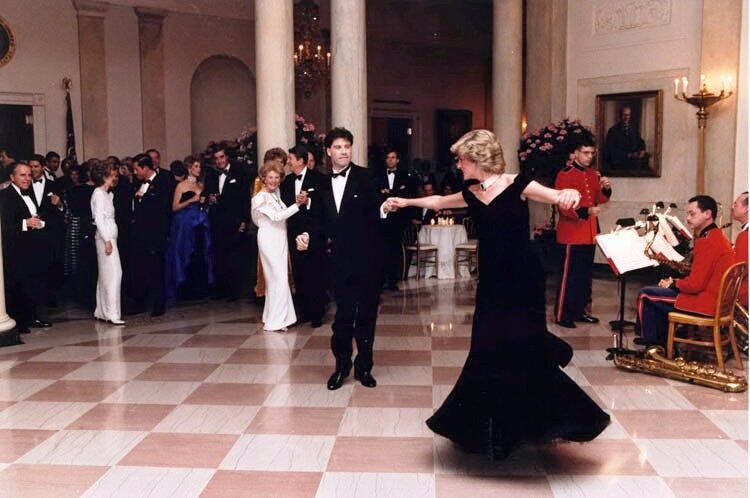
In November 1985, Princess Diana attended a White House gala dinner hosted by President Ronald Reagan and First Lady Nancy Reagan. She wore an ink-blue velvet off-the-shoulder gown by British designer Victor Edelstein — and she danced with John Travolta. The image of Diana waltzing with the Saturday Night Fever star in that gown became one of the defining photographs of her life, the kind of picture that captures a moment of pure, uncomplicated joy.
The dress itself is a masterpiece of understated elegance — deep midnight blue, form-fitting, simple in its lines yet extraordinary in its effect. It later became one of the ten dresses Diana chose to auction for charity in New York in 1997, just two months before her death. It remains one of the most sought-after pieces of royal fashion in existence, and was subsequently loaned to the Diana: Her Fashion Story exhibition at Kensington Palace.
The Catherine Walker Elvis dress — pearls, sequins and pure glamour
French-born designer Catherine Walker was one of Princess Diana’s closest and most trusted collaborators, creating over a thousand garments for the Princess of Wales during her lifetime. Of all of them, perhaps the most memorable is the white silk strapless gown with a matching bolero jacket that Diana wore during an official visit to Hong Kong in 1989. The dress was encrusted with pearls and sequins across the bolero in a pattern so lavish that it immediately drew comparisons to the King of Rock and Roll — and the “Elvis dress” nickname has stuck ever since.
The dress represents a significant shift in Diana’s fashion identity — away from the frothy, romantic gowns of her early royal years and towards a sleeker, more tailored silhouette that better reflected the confident, independent woman she was becoming. It was, in many ways, a visual manifesto — the kind of dressing that has since inspired everything from red carpet fashion to the broader cultural conversation about clothing as communication, something Diana pioneered decades before it became a mainstream idea.
The pale blue Catherine Walker gown — Cannes 1987
Among all of Catherine Walker’s creations for Diana, the pale blue strapless chiffon gown she wore at the 1987 Cannes Film Festival holds a special place. Worn with a matching scarf tied loosely so it flowed behind her like a second train, the dress had an almost otherworldly quality — ethereal, romantic and effortlessly beautiful. It is perhaps the best example of Diana at her most classically elegant, the kind of look that requires no context or explanation to understand its power.
By 1987, Diana had already established herself as one of the most photographed women in the world, and her presence at Cannes drew the kind of attention usually reserved for the festival’s biggest film stars. The pale blue gown was entirely worthy of the occasion. It sits, alongside the wedding dress and the Revenge Dress, as one of the three or four images that most immediately spring to mind when people think of Princess Diana and fashion.
Why Princess Diana’s dresses still matter
Princess Diana’s wedding dress, the Revenge Dress, the John Travolta gown, the Elvis dress — each of these pieces is far more than a beautiful garment. Each one marks a chapter in her life, a moment of transformation or a statement of identity. Taken together, they form a visual autobiography of one of the most compelling figures of the twentieth century. As British Vogue has noted, Diana’s influence on fashion remains as powerful today as it was during her lifetime — her looks continue to be referenced on red carpets and runways around the world, and her instinctive understanding of clothes as communication has never gone out of style.
She was, in the truest sense, a woman who dressed for herself — for the message she wanted to send, the person she wanted to be seen as, the feelings she wanted to convey. That is why her dresses still resonate. They were never just clothes. They were always, in some way, a conversation.