
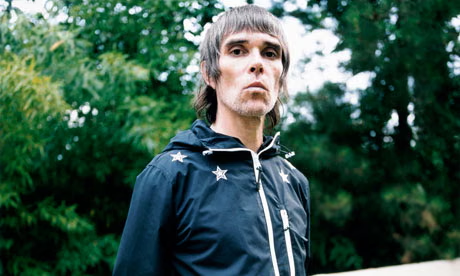
Ask anyone who lived through the late 1980s and early 1990s British music scene and they will tell you exactly who the lead singer of the Stone Roses is. Ian Brown — born Ian George Brown on 20 February 1963 in Warrington, England — is one of the most iconic frontmen British rock has ever produced, and the Stone Roses lead singer whose voice, swagger and stage presence helped define a generation.
But who exactly is Ian Brown, what made the Stone Roses so special, and what has he been up to since? Here is everything you need to know.
Who is Ian Brown, the lead singer of the Stone Roses?
Ian Brown is an English musician, singer and songwriter who served as the lead singer and only continuous member of the Stone Roses from the band’s formation in 1983 right through to their final split. Raised in Timperley, Greater Manchester, Brown grew up immersed in the city’s vibrant music scene — influenced by artists ranging from The Smiths and New Order to reggae and psychedelic rock — and channelled all of it into a stage presence that would eventually make him one of the most recognisable faces in British music.
As the Stone Roses lead singer, Brown brought a laid-back, almost effortlessly cool quality to everything the band did. His vocals were not conventionally powerful in the way of a stadium rock belter — they were something else entirely. Wry, melodic, understated and deeply charismatic, his voice became the perfect vehicle for the band’s jangly guitars and dancefloor-ready rhythms. It is a sound that has never really dated.
The Stone Roses — how it all began
The Stone Roses formed in Manchester in 1983, with Brown at the centre alongside guitarist John Squire, bassist Mani and drummer Reni. It took them several years to find their audience, but when the band finally broke through in the late 1980s, the impact was seismic. Their self-titled debut album, released in 1989, is widely regarded as one of the greatest British albums ever made — a record that blended psychedelic rock, funk-inflected basslines and dancefloor energy into something that felt genuinely new.
Singles like I Wanna Be Adored, She Bangs the Drums and the anthemic I Am the Resurrection became defining songs of the era. The band’s Spike Island concert in 1990 — attended by around 27,000 people on a chemical works site in Cheshire — has gone down in music folklore as one of the great live events in British rock history. At the centre of all of it was the Stone Roses lead singer, whose cool, unshakeable stage presence gave the whole thing its particular energy.
The Madchester movement and the Stone Roses’ legacy
The Stone Roses were central figures in the Madchester movement — a fusion of indie rock, psychedelia and acid house that emerged from Manchester in the late 1980s and briefly made the city the undisputed centre of British popular culture. Alongside bands like the Happy Mondays, the Stone Roses helped soundtrack a moment in British youth culture that felt genuinely euphoric, a sense of possibility that came from nowhere and burned brightly before fading just as quickly.
The band’s second album, Second Coming, finally arrived in 1994 after a protracted, difficult recording process — and while it was received with mixed reviews at the time, it has since been reassessed more generously. By 1996, the Stone Roses had split, with John Squire departing first and the band dissolving shortly after. It felt, at the time, like the end of something significant. It was.
Ian Brown’s solo career after the Stone Roses
Rather than disappear from view after the Stone Roses split, Ian Brown embarked on a solo career that proved both prolific and, at its best, genuinely brilliant. His debut solo album Unfinished Monkey Business arrived in 1998 and was a statement of intent — experimental, bass-heavy and deeply personal. The single Corpses in Their Mouths and the solo classic F.E.A.R. became fan favourites, demonstrating that the lead singer of the Stone Roses had plenty more to say without the band behind him.
Over the following two decades he released seven studio albums in total, each one exploring different sonic territory — from trip-hop and electronica to reggae-inflected rock and acoustic balladry. His solo work has been characterised by the same fearless independence that defined the Stone Roses at their best, and by a willingness to court controversy that has made him as talked-about for his opinions as for his music. For more on musicians who have carved their own distinctive path, check out our piece on Amy Ginger Hart’s tribute to Dolly Parton — another artist who, like Brown, lived by her own rules entirely.
The Stone Roses reunion — and what came next
In 2011, Ian Brown and the Stone Roses announced a reunion that sent the music world into a frenzy. The band — Brown, Squire, Mani and Reni all back together — played a series of enormously successful concerts including headline slots at major festivals, and reminded an entire generation exactly why the Stone Roses lead singer was so special in the first place. The reunion shows were a reminder of the band’s power: the music still landed, the crowds still knew every word, and Brown still had that ineffable quality — the sense that he simply could not care less what anyone thought, and that this was precisely why everyone cared so much.
The reunion eventually wound down without new material, and Brown returned to his solo endeavours, releasing First World Problems in 2018. The Stone Roses have not announced any further activity since, though the possibility of another reunion is never entirely off the table where Manchester’s greatest band is concerned. You can read more about the band’s history and legacy over at Rolling Stone, which has covered the Stone Roses extensively across their career.
Why Ian Brown remains one of Britain’s great rock icons
Whether you know him as the lead singer of the Stone Roses, as a provocative solo artist or simply as one of the defining faces of the Madchester era, Ian Brown’s place in British music history is secure. He is, in the words of those who have followed his career from the beginning, equal parts controversial and adored — a frontman whose influence stretches far beyond the records he made, into the way a generation of British musicians approached their craft, their image and their relationship with their audience.
The Stone Roses lead singer turned 63 in February 2026, and shows no signs of fading from relevance. His music continues to be discovered by new generations, his opinions continue to generate headlines, and his status as one of the great British rock frontmen continues to grow rather than diminish with time. Not bad for a lad from Warrington.